ITO CHIHO
伊藤 千穂
ITO CHIHO
伊藤 千穂
At a Glance
| Location | Seto, Aichi Prefecture, Japan |
| Founded | 1999 |
| Style | Oribe, Seto, Kirameki |
| Kiln | Gas |
| Clay | Seto and Shigaraki |
| Glaze | Shikoku, Edelmetalle |
Ito Chiho: New Interpretations of the Oribe Tradition
Table of content

Narumi Oribe Tea Bowl - Seto Gura Museum - 1. half of 17th Century
Seto and Oribe – Brief Overview
History
Seto ware is an important part of the Japanese ceramic tradition and has a long and rich history dating back to the 5th century. It refers both to ceramics produced in the Seto area and in the neighbouring Mino region. The town of Seto, located in Aichi Prefecture, is one of Japan’s “Six Ancient Kilns”. Among these historic kiln centres, Seto was the only one to produce glazed ceramics at the time, which allowed it to develop into a major centre of ceramic production.
The diversity of styles and the level of creativity found in Seto were virtually unparalleled. As a result, the term “Seto-mono” was once used as a general synonym for ceramics in Japan.
Various styles: Oribe, Kuro-Seto, Ki-Seto, etc.
The best-known styles of Seto ware include the Mino styles such as Shino, Oribe, Kuro-Seto, and Ki-Seto. These styles are closely connected to the tea ceremony, whether as tea bowls or as tableware for cha-kaiseki, the meal served during a tea gathering. Another notable style is Sometsuke porcelain with cobalt-blue underglaze decoration, which, according to tradition, was brought to Seto from Kyushu by Kato Tamikichi more than 200 years ago.
Oribe ware is distinguished by its geometric and painterly compositions created with iron oxide and green glaze. Its asymmetrical forms appear strikingly modern.
Kuro-Seto is known for its deep black glaze, created through the “hikidashi” process: the ceramic is removed from the kiln at the height of the firing and rapidly cooled, resulting in a strikingly black finish.
Ki-Seto features a yellowish glaze distinguished by its richness and luminosity. Ki-Seto pieces are often decorated with incised motifs inspired by nature, highlighted with green copper glaze (tanpan).

Ito Chiho
From Owari-Seto Station, it is only a short walk to Ito Chiho’s studio through a town surrounded by hills. Right outside the station, the first ceramic shops appear, while the bridges crossing the river are decorated with ceramics, displaying small treasures. At every corner, ceramic works can be found adorning the walls of the town.
Ito Chiho’s atelier is located in a residential neighbourhood, not far from Kamagaki no Komichi, the so-called “Pottery Path”. After the long journey from Tajimi, I am warmly welcomed by Ito Chiho’s hospitality: tea served in a beautiful bowl, accompanied by a delicious sweet.
Ito Chiho does not come from a ceramic family. Originally trained as a hair stylist, her dream was to open a gallery. However, life eventually led her to ceramics. In Seto, she completed her ceramic training and founded her studio in 1999.
She finds her inspiration in the traditional tea ceramics of Seto. As her mother is a trained tea master and cha-kaiseki cook, she grew up with a strong awareness of the importance of vessels in the context of food and tea from an early age. As a result, her ceramics are predominantly tea ware and, in terms of form, are typically rooted in local Oribe and Seto styles.

KURO-ORIBE AND KIRAMEKI
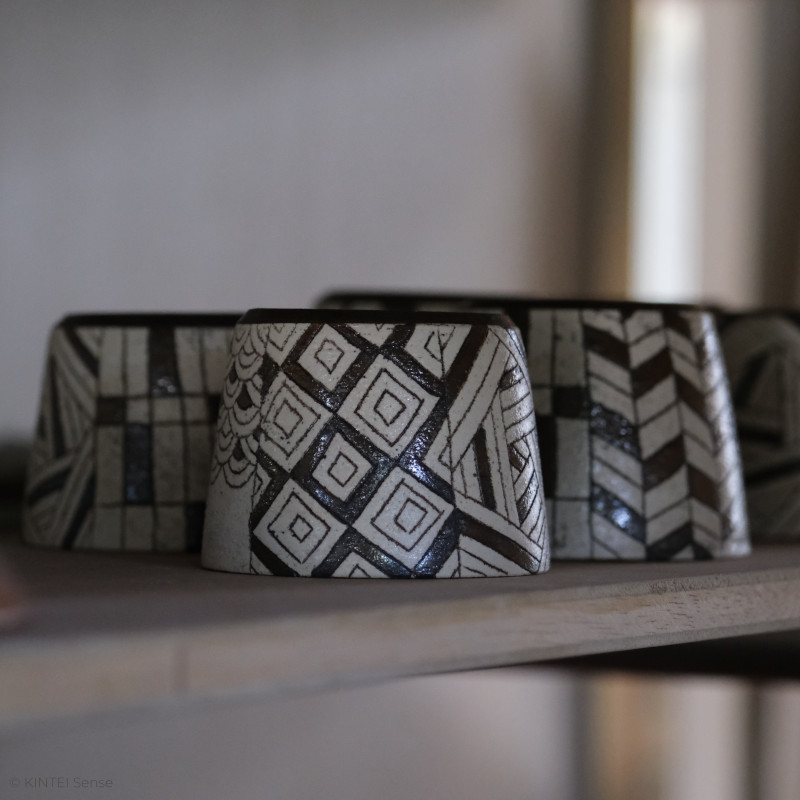
Ito Chiho works across a range of styles in her portfolio. She combines traditional green and black Oribe ceramics with contemporary elements and has developed two modern interpretations: a “Black Line” series that blends matte and glossy black glazes with abstract designs and gold accents, and her Kirameki (煌めき, “glittering / sparkling”) line.
This particularly distinctive series is somewhat reminiscent of Klimt: engraved geometric yet asymmetrical patterns rendered in gold, silver, and platinum.
Ito Chiho has a strong fascination with pattern. Japanese design culture encompasses a rich variety of wagara (和柄, traditional patterns), whose symbolic meanings are widely understood and continually reinterpreted across visual culture in Japan—for instance, motifs such as ocean waves.
Among these, kichimon (吉文, auspicious motifs) are especially valued and frequently used.
Ito Chiho uses local clay from Seto and Mino for her work—particularly Mino clay for her tea bowls. To achieve greater stability, she sometimes blends in clay from Shigaraki.
Her creations are either wheel-thrown or built using slab construction techniques, allowing her to realise geometric forms such as the fan plates.
Ito Chiho’s delicate decorations and designs are meticulously incised freehand, without stencils, into leather-hard clay coated with a white slip, using a needle tool. Iron oxide is then applied and wiped away to emphasise the engraved lines.
Inside her bowls and mukozuke vessels, one often finds a glossy, dark brownish-red glaze reminiscent of lacquerware. Ito Chiho refers to this glaze as Shikoku-yū (紫黒釉, “purple-black glaze”), which contains manganese, iron, and copper.
As wood-fired kilns are no longer permitted in the city, she uses a gas kiln with side burners. Her pieces are fired in three stages: an initial bisque firing at 700°C, a glaze firing at 1240°C, and a final firing at 750°C for the gold and platinum applications.

The Seto Gura Museum
Finally, a small recommendation for the Seto Gura Museum. It is a must-visit for anyone interested in the history and art of Seto ceramics and spending some time in Seto. The museum offers a comprehensive exhibition tracing the development of ceramics in Seto from its origins through to the modern era. Visitors can admire an impressive collection of historical and contemporary ceramics and learn more about the techniques and materials used in the creation of these works.
Seto ware is not only an expression of centuries-old tradition but also a vibrant part of the contemporary art world. With artists such as Ito Chiho, who combine traditional techniques with contemporary design, Seto remains a key destination for ceramics enthusiasts worldwide.