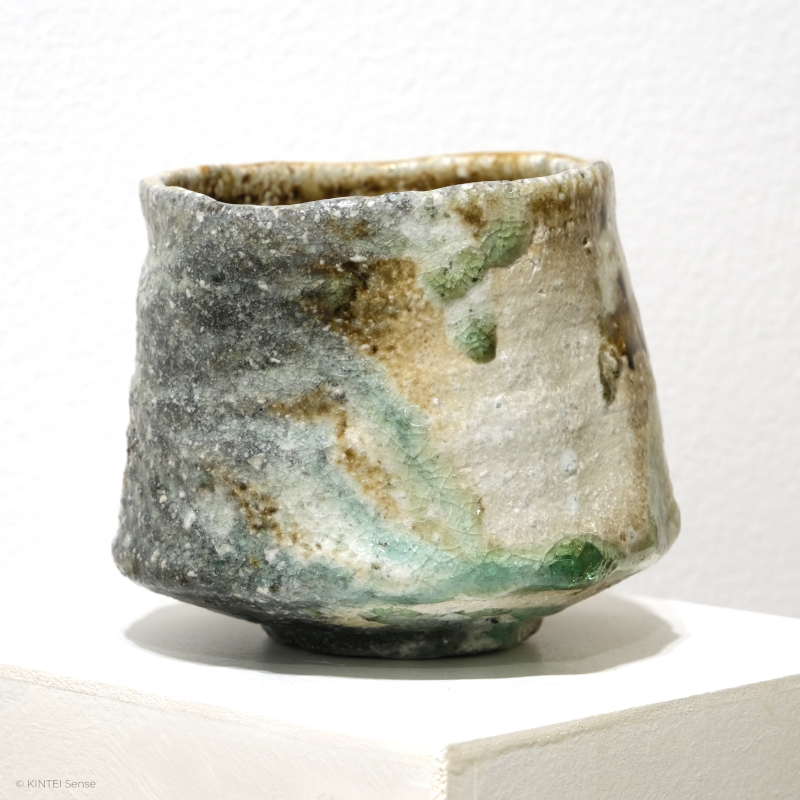
Bizen Ceramics
Of Fire and ClayBizen – a story of fire...
Anyone fascinated by fire will be drawn to Bizen ceramics (Bizen Yaki 備前焼). Few other Japanese ceramic traditions reveal the interplay of natural elements with such immediacy.
Bizen Yaki, named after the region of Bizen in Okayama, between Osaka and Hiroshima, has a long history. Its tradition dates back to the Kofun period, and over the centuries Bizen developed into one of Japan’s most important centres of ceramics.
With the growing importance of the tea ceremony during the Momoyama period (1568–1600), Bizen ceramics also acquired a new aesthetic significance. The simplicity of its unglazed, iron-rich clay and the visible traces left by the fire resonated with the restrained, understated Wabi aesthetic of the tea ceremony.

The importance of Bizen can also be seen in its historic kilns. The large Ōgama (大窯) kilns of Imbe bear witness to the scale of production in the past. One of these historic kilns was almost 54 metres long. Shared by the entire village, it enabled firings lasting more than 30 days, forming an important foundation for local ceramic production.
To this day, fire remains an essential element of Bizen ceramics. Traditionally fired in an Anagama or Noborigama kiln, the pieces are left unglazed, allowing the surface to be shaped by the firing itself. What ultimately emerges is the result of the interplay between clay, flame, ash, temperature and time.
and Clay...
As important as fire is to Bizen, everything begins with the earth.
The distinctive clay sourced from rice fields – Tatsuchi (田土), a highly prized and rare clay – as well as from the mountains – Yamatsuchi (山土) – reveals its particular depth in the fire. Bizen clays are generally characterised by high shrinkage during firing, making them less suited to conventional glaze firing. It is in wood firing, traditionally known as Yakishime (焼締め), that they reveal their full expressive potential.
In Yakishime, the clay is fired and vitrified at high temperatures without any applied glaze. Its characteristic surfaces emerge solely through the interplay of material and fire. During the long wood firing, ash settles on the vessels, partially melting and leaving behind natural, glaze-like surfaces. The flames may create reddish, orange or dark traces. Depending on the position within the kiln, the duration and intensity of the firing, entirely different effects can emerge.

These transformations brought about by the firing are known as Yōhen (窯変), literally meaning ‘change in the kiln’. What may appear to be a matter of chance, however, requires an immense depth of knowledge and experience: an understanding of different clays, how to arrange the kiln, the movement of flames and ash, the duration of the firing, and the development of temperatures.
Bizen ceramics has its own vocabulary for the different effects created by the fire. Goma (胡麻), for example, refers to the small, glaze-like yellowish-brown flecks that resemble sesame seeds, while Hidasuki (緋襷) describes the characteristic red lines that form when the clay comes into contact with rice straw during firing.
It is precisely this interplay between knowledge and unpredictability that gives Bizen firing its particular appeal.

Bizen is still closely associated with traditional forms such as vases, water vessels, tea bowls and sake ware. At the same time, artists continue to explore freer and more unconventional forms, blurring the boundaries between vessel and sculpture.
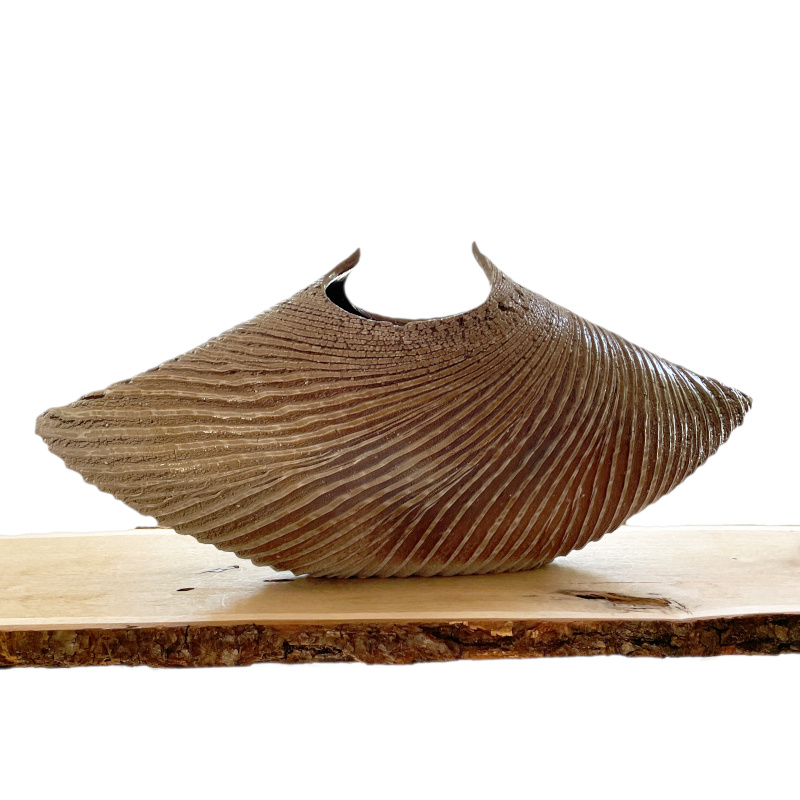
Ishida Kazuya belongs to a younger generation of Bizen artists who draw deeply on this tradition while forging their own path. His distinctive works combine Bizen clay and wood firing with a pronounced spiral-shaped formal language.
Bizen remains a living ceramic tradition: deeply rooted in its place, its materials and its fire, yet open to new forms and individual expressions.
In both cases, the natural quality of the unglazed clay, together with the interplay of fire and ash, gives these works a distinctive presence and strength.
Explore Bizen ceramics at KINTEI Sense – from traditional Yakishime works to contemporary interpretations by artists such as Baba Takashi and Ishida Kazuya.
A unique interplay of elements
Today, Bizen remains one of Japan’s most important ceramic regions. Its long history is not confined to the past. A new generation of ceramic artists continues to carry the tradition forward, finding new ways to interpret and express it.
In the 1930s, Kaneshige Tōyō played a major role in reviving the celebrated ceramic tradition of the Momoyama period. In 1956, he became the first Bizen ceramic artist to be designated a Living National Treasure. He was followed by Fujiwara Kei (1970), Yamamoto Tōshū (1987), Fujiwara Yū (1996) and Isezaki Jun (2004).
Isezaki Jun and other contemporary ceramic artists such as Kakurezaki Ryūichi, have played an important role in keeping Bizen ceramics alive and continuing to expand its expressive possibilities.
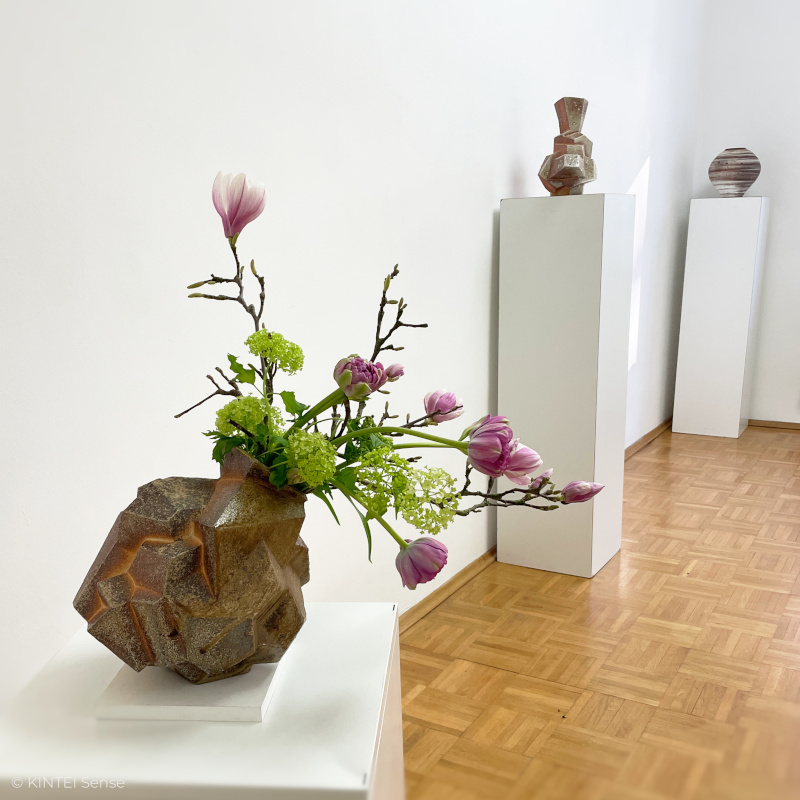
Exhibition Dō – The Way of Clay 2026
Kintei Sense
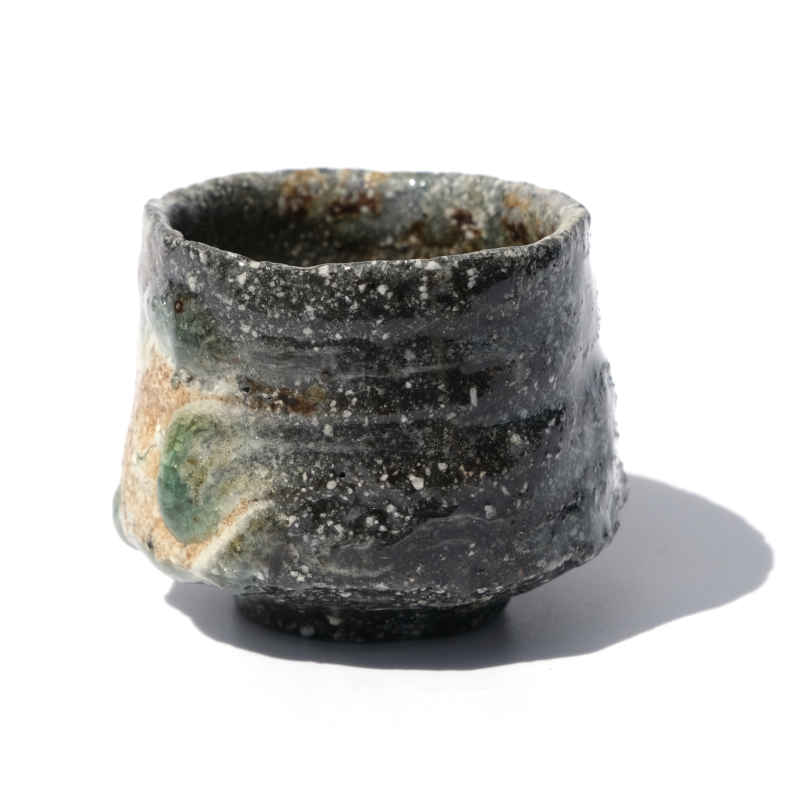
Sake Ceramics
Kintei Sense

Tea Ceremony and Japanese Ceramics
Kintei Sense
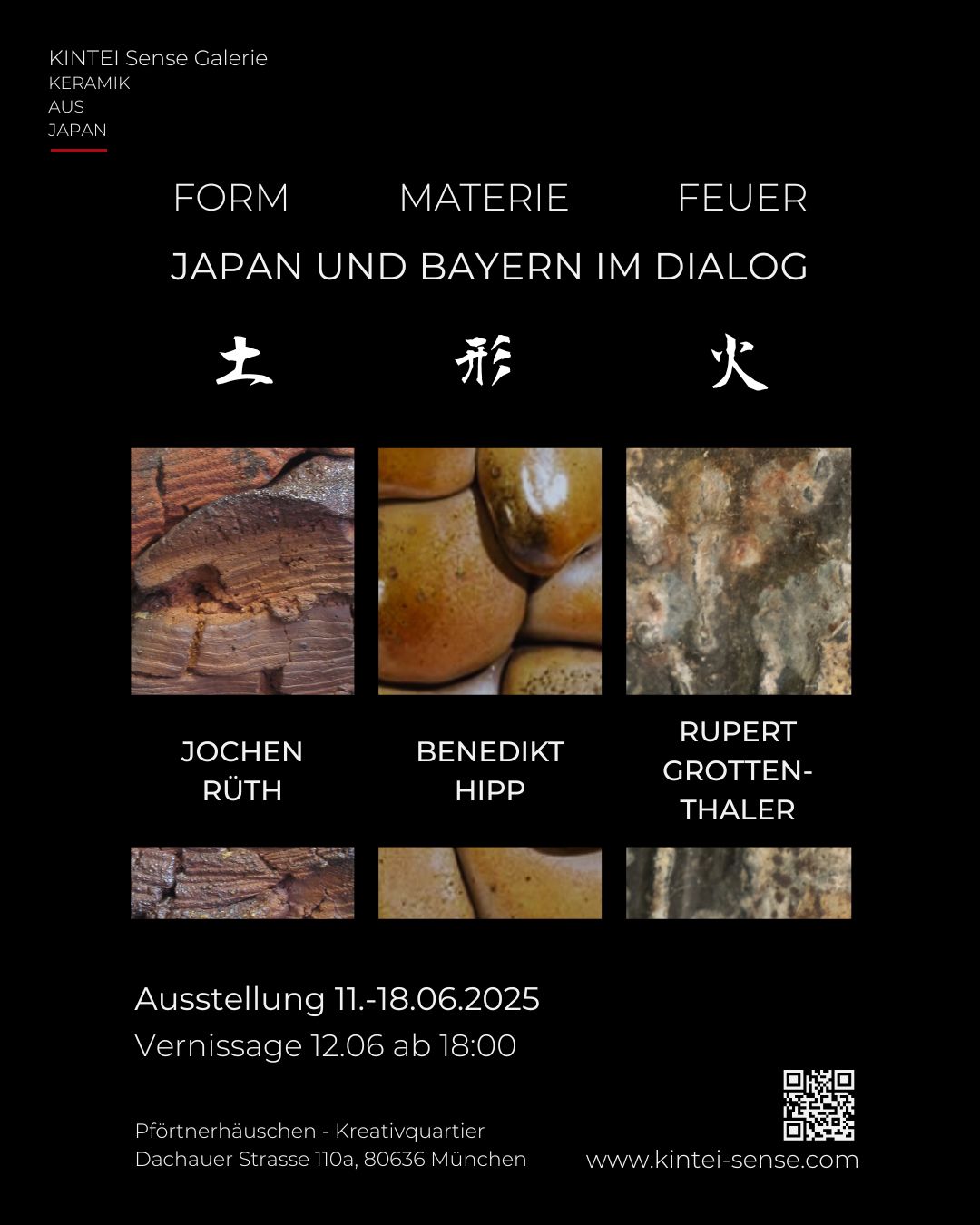
Exhibition Japan and Bavaria in Dialogue 2025
Kintei Sense
Exhibition Nature in Motion 2025
Kintei Sense