KISARAGI GAMA 如月窯
YUKINOURA YUICHI
雪ノ浦 裕一
At a Glance
| Location | Morioka, Iwate Prefecture, Japan |
| Founded | 1985 |
| Style | Kaiyū, Kohiki, Hakeme |
| Kiln | Electric and Gas |
| Clay | Local clay from Morioka, Touno, Hanamaki, Shigaraki Ton |
| Glaze | Natural ash glaze (Kaiyū) from various apple tree varieties |
A DAY IN THE KISARAGI GAMA STUDIO
Kisaragi means “second month” and was named so because both Yukinoura-sensei and his wife were born in February. His studio is tucked away on a small hill at the northern edge of Morioka, right beside a small lake. A beautiful path lined with red pines leads up to it. The atelier is quite spacious and offers a fantastic view over the city.
He also lovingly tends a garden of remarkable variety: figs, artichokes, strawberries, asparagus, taro potatoes, and much more. Beehives can also be found in the backyard.
In his studio, the scent of katorisenkō—mosquito-repellent incense sticks—evokes memories of my time in Japan and of my own studio in France. Natsukashii, like Proust’s madeleine!

Yukinoura Yuichi, from mathematics to ceramics
No sooner had we arrived than Yukinoura Yuichi was already showing his work—how he gathers clay from his own garden, and how he has developed his own glaze recipe and firing process. To my great delight, Yukinoura-sensei spontaneously demonstrated two different techniques.
The speed and ease of his actions stand in contrast to the demanding preparations required beforehand: sourcing and preparing the clay, making plaster moulds, applying glazes, firing, and of course the countless trials needed to achieve the desired results. As Hamada Shōji once said about making a single cup, when asked about the apparent speed of his wheel work: “15 seconds plus 60 years.”
Originally, Yukinoura Yuichi studied mathematics. His fascination with numbers is reflected in his creations, starting with their geometric forms. The precision with which he works—particularly in the analysis and preparation of clay and glazes—can likewise be attributed to his scientific background.
Yukinoura Yuichi established his workshop, Kisaragi Gama, in Morioka, Iwate Prefecture. However, this region is not typically associated with ceramics, as the local grey, light clay is difficult to work with and even more challenging to bring out aesthetically. Nevertheless, Yukinoura has fully committed himself to the local conditions—his terroir, so to speak.

LOCAL CLAY
Yukinoura Yuichi uses three different types of clay, depending on the style he is aiming to achieve:
- His own clay from Morioka, which he personally digs from his garden. This untreated clay is rich in iron and must be processed before use. Yukinoura Yuichi removes larger roots and coarse impurities, but deliberately leaves smaller stones or pebbles in the clay to give it a certain texture.
- Tōno and Hanamaki clay, also local clays from Iwate Prefecture. Hanamaki clay is particularly well suited to his ash glazes, as it allows for fine fissures (cracks) in the glaze, resulting in a more delicate, glass-like surface pattern.
In addition to the local clay, which—as mentioned—can lack plasticity and is sometimes not fully satisfactory in terms of colour, Yukinoura Yuichi also occasionally blends in clay from Shigaraki or Mino, as well as a small amount of porcelain body from Amakusa.

APPLE TREE ASH GLAZES
In my research into Yukinoura Yuichi’s work, I noticed not only his deliberate commitment to working with local clay—even though it is not ideally suited to ceramics—but also how he carries this local ethos through the entire making process.
Thus, he uses ash from apple tree branches as the base for his natural Kayū ash glaze. In fact, Iwate Prefecture, with its wide variety of apple cultivars, is known as “the” apple region of Japan—so there is certainly no shortage of material.
To achieve the unique wabi-sabi-like grey-brown tone of his bowls, Yukinoura Yuichi carried out countless experiments. He documented them meticulously, working with different clay bodies, temperatures, firing methods, and various apple tree varieties and glaze recipes, while carefully tracking the chemical changes under different conditions—such as the behaviour of iron in the clay during reduction and oxidation firings.
.

FIRING ELEMENTS and GLASS EFFECTS
For firing, Yukinoura Yuichi primarily uses an electric kiln, as the turquoise glass effect he aims to achieve with his Kaiyū ash glaze is best realised in this type of kiln. A gas kiln would be too unpredictable and not precise enough. His workshop features an impressive kiln room with four electric kilns and a large gas kiln. I was also struck by the many shelving and storage surfaces—remarkable, considering he works alone. I know quite a few people who would certainly be envious of this space.
The firing process is quite complex, as the various pieces undergo different stages of reduction and oxidation. These phases, and the order in which they occur, influence the final colour outcome, which in the glass effects can range from greenish and brownish to bluish tones.
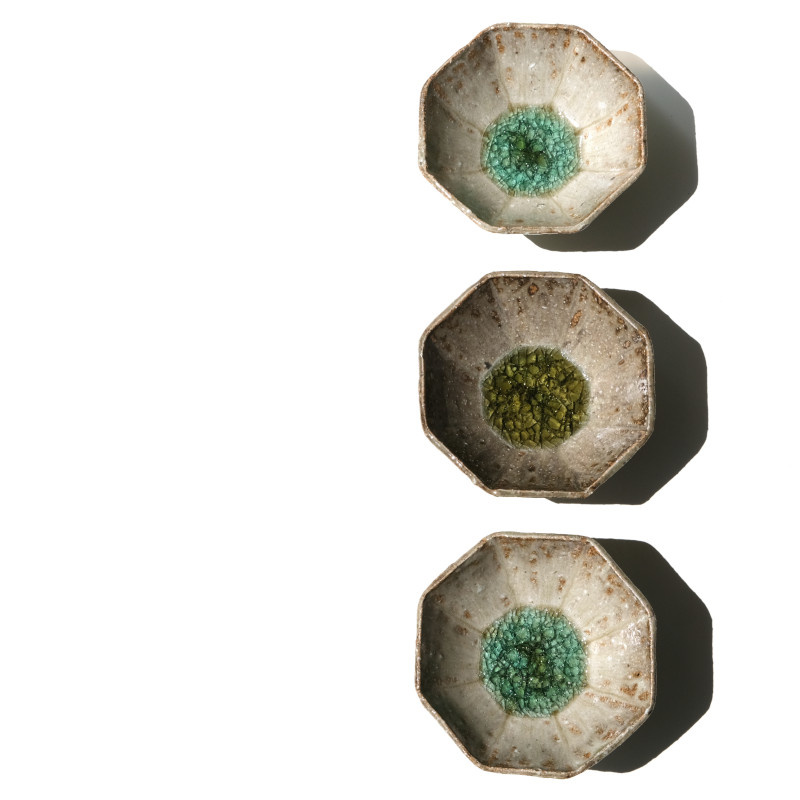
To achieve the desired vitrification effect, each piece is built up with four glaze layers based on apple tree ash and feldspar. Depending on the intended colour direction, additives such as cobalt or manganese may also be included. The first layer, an iron oxide–enriched ash glaze, is applied thinly and bisque-fired at 830°C. This is followed by a second layer, a feldspar-based glaze, which is also bisque-fired at 830°C. Finally, the last two layers of ash glaze are applied successively and glaze-fired at 1280°C.
.

YUKINOURA'S PHILOSOPHY
Yukinoura Yuichi deliberately applies his scientific approach to the making of tableware, as for him the true beauty of his creations only emerges in connection with food. Although he also produces more sculptural works for exhibitions in Japan, the grounded, functional aspect remains of greatest importance to him.
The result is a wonderfully soft and poetic ceramic. His Kaiyū glaze evokes fresh mountain lakes through its natural colours and the vitrification, which brings the tableware to life with varying degrees of glass-like sheen. Even in the forms, which are highly geometric, his mathematical sensibility becomes evident once again.
After all these explanations and demonstrations, I was led into what felt like Alibaba’s cave—a small exhibition room overlooking the city. Choosing among so many remarkable pieces proved to be a difficult task. I ultimately tried to keep the selection coherent, focusing on works made from local iron-rich clay, reduction-fired to achieve a distinctive grey sheen combined with the emerald-green glass effect of the apple ash glaze.
As always, each piece is unique.