ISHIDA KAZUYA
石田 和也
ISHIDA KAZUYA
石田 和也
At a Glance
| Location | Imbe, Bizen, Okayama Prefecture, Japan |
| Founded | 2013 |
| Style | Bizen, Yakishime, Slipware, Porzellan |
| Kiln | Anagama, Noborigama |
| Clay | Local clay and porcelain from Bizen |
| Glaze | Unglazed (Yakishime), natural ash glaze |
Just a few minutes from Baba Takashi’s studio lies the studio of Ishida Kazuya. The path from the road passes large ceramic sculptures and opens up a view of the wide valley. In the distance, the Shinkansen can be seen gliding past the rice fields.
Ishida Kazuya’s studio is divided across several buildings: the two kilns in the firing hall, and the atelier located opposite the modern showroom. A perfect setting for photography!

BIZEN AS THE ORIGIN
Ishida Kazuya’s creations originate in Bizen. Born in 1986 into a family of potters, his hometown has deeply shaped his artistic style.
Bizen is regarded as one of the six ancient kilns (Rokkoyō). With a history spanning over 1,000 years, it has established itself as one of Japan’s most important ceramic centres. The local clay is particularly well suited for unglazed, high-fired ceramics known as yakishime. With the spread of the tea ceremony, Bizen gained further significance for chanogu—tea utensils such as tea bowls, water jars, and vases.
True connoisseurs appreciate Bizen for its slightly rough, rustic and understated character. Various wood-firing effects such as goma (sesame seed ash deposits), ash glaze effects, or botamochi—round motifs created by shielding—are highly sought after. The significance of Bizen ware, which may appear austere or shibui at first glance, is reflected in the number of Living National Treasures it has produced. There have been five so far, with Isezaki Jun being the current titleholder.
After completing his studies at the ceramic schools in Bizen and Kyoto, Ishida Kazuya trained for four years under none other than the aforementioned Isezaki Jun. There, he learned the skills of wheel-throwing and firing, as well as the significance of Bizen and its cultural heritage.

International influence adding further complex layers
His international residencies have also influenced his work, adding further complex layers. In fact, in 2011 and 2012 Ishida Kazuya gained experience in two pottery studios in the United Kingdom, and later also took part in an artist-in-residence programme at the Leach Pottery. There, he studied traditional English slipware (engobe) techniques in depth, which he skillfully reinterprets and incorporates into his own creations.
In 2013, Ishida Kazuya built his own kiln in Bizen. However, his return to Japan did not diminish the influence of his international experience. He continues to work closely with the University of Oxford on projects related to anagama kilns and serves as a consultant on their construction. By now, he has also gained further experience in the United States and more recently in Australia.

Rahō: Nature as Inspiration
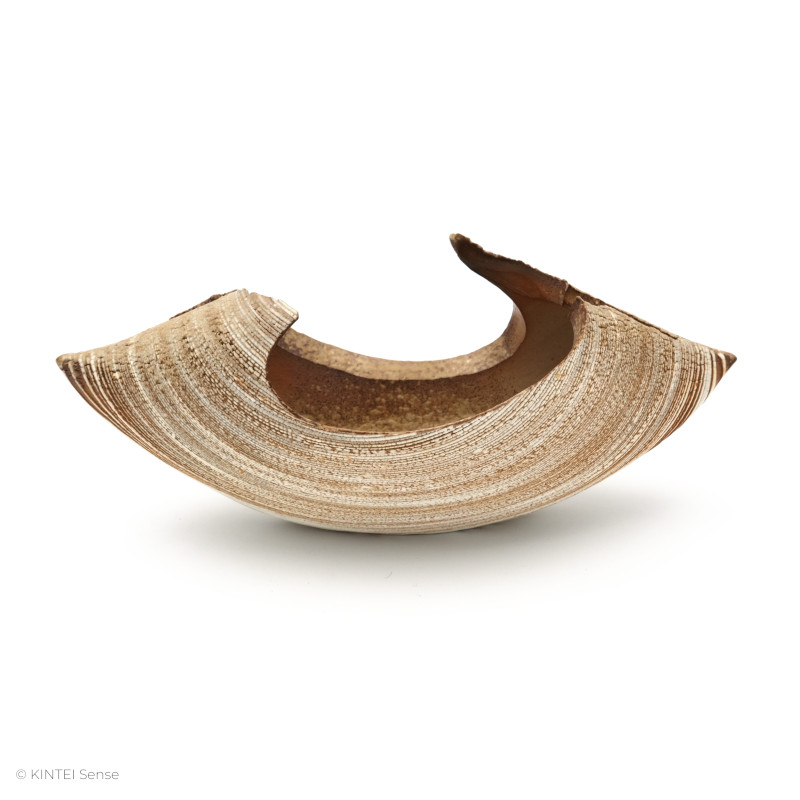
Ishida Kazuya draws inspiration from nature for his creations. Sea creatures, shells, and geological phenomena such as marine deposits, rock strata, and stalactites serve as his references. They express a certain dynamism and movement of nature, which is reflected in his works.
Through his diverse experiences, Ishida Kazuya combines different techniques. He methodically prepares his own Bizen clay, which he then enriches after an initial throwing with white porcelain slip using the English slipware method and various patterns. Leveraging the centrifugal force of the wheel, he gives his works a distinctive spiral momentum and sense of movement that defines his practice. He refers to this style as Rahō (螺法), inspired by the spiral forms of sea snails.
He fires his pieces—without glaze—depending on the effects he wants to achieve, either in his self-built anagama kiln or a noborigama kiln. During firing, the flame and ash deposition create colour variations known as yōhen and additional patterns, giving his works even greater depth and natural character.
Following the Bizen tradition, Ishida Kazuya focuses on functional ceramics, mainly vases that are ideal for ikebana, as well as vessels for tea and sake.
It is certainly no surprise that his works have already received several awards. Ishida Kazuya also regularly exhibits in galleries in Japan as well as abroad.

NEW DEVELOPMENTS: BIZEN WILD PORCELAIN
A recent focus of Ishida Kazuya is porcelain—somewhat unexpectedly for a Bizen based artist, a region best known for its unglazed yakishime stoneware tradition. Surprisingly however, beneath the area, at depths of around 150 meters, lies a porcelain deposit that typically feeds industrial ceramic production in Seto. Ishida-san has begun working with this material, introducing a new dimension to his practice and expanding his artistic language.
He sources and processes the porcelain himself, allowing him to select clumps that are particularly interesting to him. Depending on the collection, Ishida Kazuya works the “wild” porcelain in different ways: kept very natural for his artistic tea bowls, left slightly rough for porcelain cups whose small iron particles create lively variations in colour, or finely sieved and purified for the marbled, soft surfaces of his Abyss line. In this way, he creates vessels that can appear either raw and organic or smooth and elegant.
Whether wild porcelain bowls, cups, or Abyss bowls and teapots—Ishida Kazuya makes the material’s diversity directly tangible. While wood firing with ash deposition produces subtle and dynamic nuances, gas firing emphasizes the pure white of the porcelain. In both approaches, his aim becomes clear: to reveal the beauty and natural complexity of the material in a way that can be both seen and felt.
ISHIDA KAZUYA CREATIONS
ISHIDA KAZUYA PROFILE
2006 Graduated from the Bizen Pottery Centre
2007 Graduated from the Kyoto Pottery Technical Centre
2007–2010 Studied under Living National Treasure Jun Isezaki
2011 Worked at Kigbeare Pottery (Devon, UK)
2012 Worked at Whichford Pottery (Cotswolds, UK)
2013 Returned to Bizen, Japan to establish his own studio
2015 Ceramic exhibition in Hatfield, London
2015 Project lead for the Oxford Anagama project and construction of an anagama kiln at the University of Oxford
2015–2018 Artist-in-residence at the University of Oxford
2016–2018 Led the Bizen × Whichford project
2016 Artist-in-residence at Leach Pottery
2017 Ceramic art exhibition in London
2018 UAL: Utsuwautsushi-Symposium
2018 Organized Bizen ceramic art exhibition in Shizutani
2019 Artist-in-residence at Star Works (North Carolina, USA)
2020 Began using the new material “Bizen porcelain”
2022 Artist-in-residence at Sturt Gallery and Studio (NSW, Australia)
2023 Artist-in-residence at Canberra Potters Society (Canberra, Australia)
2024 Founded Ripple Ltd.
2024 Exhibited at Salone del Mobile (Milan, Italy)